
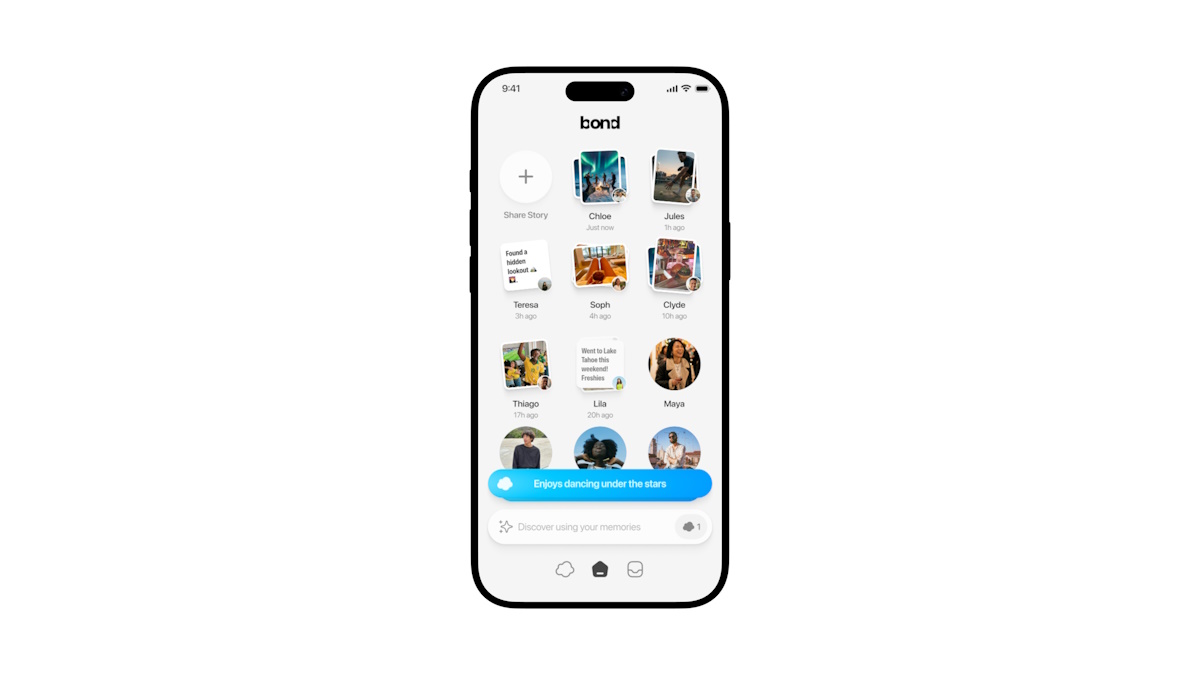
Bond Launches As AI Social App to Reduce Screen Time
Bond has officially launched on April 2st, with the stated goal of countering addictive scrolling habits by turning user-shared “memories” into personalized recommendations for real-life experiences.
Unlike traditional platforms built around endless feeds and advertising, Bond has no infinite scroll, no ads, and no public follower counts. Users post photos, videos, audio, or text about daily activities and experiences, which the app calls “memories.” These posts appear as temporary stories on profiles that disappear after 24 hours from public view but remain stored privately for the user’s archive.
The core feature is an AI system that analyzes a user’s posted memories to generate tailored suggestions. For example, frequent mentions of enjoying pho could prompt a recommendation for a well-reviewed Vietnamese restaurant nearby. Interest in heavy metal might surface upcoming concert dates for bands like Iron Maiden in the user’s area. The more users document their experiences, the more refined the AI’s recommendations are intended to become, with the explicit aim of encouraging people to spend less time on the app and more time offline.
Profiles are displayed in clusters rather than a linear feed. Tapping a profile reveals current stories and allows deeper exploration of shared memories. The interface draws some visual similarity to Instagram but prioritizes personal archiving and discovery over passive consumption.
Bond’s founding team includes experience from major tech companies. Co-founder and CEO Dino Becirovic previously worked at Kleiner Perkins, Index Ventures, and in corporate strategy at Twitter. Other members have backgrounds at TikTok, Facebook/Meta, and Google Gemini.
On the business side, Bond currently has no advertising. Long-term revenue ideas include allowing users to optionally license their anonymized memory data for AI training, with Bond taking a small cut, or integrating opt-in product recommendations that could generate transaction-based fees from merchants. The company has emphasized it will not sell data for targeted advertising and plans to add stronger privacy controls, including end-to-end encryption, over time.
